
Ball Shaped Flowers
Inspired by the Wimbledon Tennis Tournament and the current EUFA European Women’s Championship, I thought it would be fun to look at some of the ball-shaped flowers available for us to grow in our gardens. Of all the shapes of flowerheads, I think the globes are the most striking. The flower heads have the convenience of not facing in a particular direction, so look great from all angles. This is especially good when using them as cut flowers.
I’ve chosen a range of plants that include the weird and wonderful to one so common that we probably overlook them as great choices for our gardens.
Dianthus barbatus ‘Barberatus Fresh’

If you are looking for something a bit different, ‘Barberatus Fresh’ offers a ‘wow’ factor with a bright green flower head of 5cm – 10cm across. These striking sweet Willimas are short-lived perennials, so treating them as biennials may give the best results. Choose a sunny spot in well-drained soil. They will fail to thrive in a waterlogged spot or on clay soil. Height 45cm – 60cm. For a more compact variety, try ‘Green Trick’ (‘Temarisou’PBR) (p,a), which will reach 30cm height and around 20cm spread.
Allium ‘Globemaster’

There are plenty of Alliums to choose from. I like to plant smaller flowered Allium in large groups to build impact and to plant a large headed Allium at intervals across a bed to provide repeating focal points. The strap-like leaves of Allium ‘Globemaster’ grow to 1m long and it produces a globe of flowers up to 20cm across, on an 80cm high stem. Grow in full sun in a sheltered spot, or among other plants that will provide some protection. They prefer west- or south-facing position and may fail in clay soils.
Scadoxus multiflorus
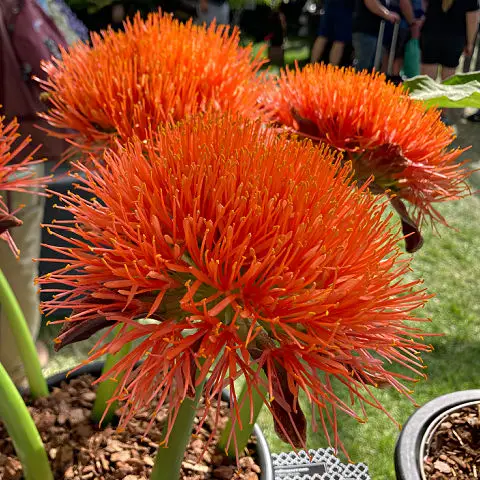
It is easy to see how the Fireball Lily got its common name. Scadoxus multiflorus is not hardy, but can be taken outside during the summer to add pizzazz to your flowering display. The flower heads are 10cm to 25cm across and contain as many as 200 flowers. Each red flower has very thin petals and long stamens giving the look of a firework. Grow in a south- or west-facing sheltered position in loamy soil or compost. Height 45cm.
Echinops bannaticus

I am fascinated by the way the flowers open from the top of the globe of Echinops. The spherical flower heads held above the thistle-like foliage and attract bees and other pollinating insects to feed on them. These fully hardy plants are easy to grow. Echinops prefers full sun or partial shade. Avoid planting in clay soil, or on a north-facing site, where they may fail to thrive. Height 1-1.5m and spread up to 1m. I find it easiest to propagate by dividing clumps in spring or autumn. For a white variety, try ‘Star Frost’.
Craspedia Globosa ‘Drumstick’

This is an evergreen perennial that is often grown as an annual from seed. It is hardy in many parts of UK, but does not always fare well in temperatures below -5. It has silvery green, hairy leaves and during the summer, 60cm tall flower stems are produced that have globe shaped, bright yellow flowerheads. The 3cm drumstick flower heads are excellent for cutting and also for drying for use in dried flower arrangements. They grow well in a sheltered position, in full sun, in loam and sandy soils, but will struggle in water-retentive and clay soils.
Dahlia ‘Copperboy’ (Ba)

Recommended to me by devoted dahlia grower Kim O’Brien, ‘Copperboy’ is a pompom dahlia. A half-hardy perennial with an upright habit that prefers full sun, but will tolerate partial shade. Grow in a south- or west-facing position in moist, but well drained soil. However, it will probably fail to thrive in chalky soils. In milder areas, it may overwinter in the ground if given some protection over the crown. For everywhere else, dahlia plants will need to be lifted, dried and stored over the winter to protect it from freezing or rotting. Height 70cm – 100cm and spread 30cm – 50cm. It has won the RHS award of Garden Merit.
Hydrangea arborescens ‘Annabelle’

‘Annabelle’ has been the darling of garden designers for several years, planting it to create beautiful low hedges. But recently I’ve seen a bit of backlash, saying that the plant is boring or predictable. Well, I think predictable in a plant can be a good thing, it means we can be sure it’ll perform in a certain way under one set of conditions. So, if you are looking for a lower-growing hydrangea with very large spherical flower heads up to 25cm across, then maybe ‘Annabelle’ is the right choice for you!
The tiny flowers are hidden among large creamy white bracts. The flowers are sterile, so it won’t self-seed all over your garden. Grow in acid or neutral soil, in any aspect in full sun or partial shade. It likes that elusive ‘moist, but well-drained’ soil and will tolerate well-drained soil. It is unlikely to thrive in chalky soil. Hardy across the UK and Ireland. Height and spread 150cm. Propagate by cuttings.
Santolina rosmarinifolia subsp. rosmarinifolia

Green cotton lavender is a spreading, evergreen plant with finely dissected leaves and bright yellow flowers that are held aloft. Grow in full sun on a west- or south-facing site in all soils, except clay. It prefers a free-draining and sheltered position. Hardy across UK and Ireland. Height and spread around 75cm. I can’t provide suitable growing conditions for it on our north-facing, windy hillside, but a couple of years ago I spotted it growing well at the Botanical Gardens of Wales.
Allium schoenoprasum

So commonly grown in our gardens that it is easy to overlook the value of chives in the flower bed. They produce a great display of flowers in late spring and early summer. Deadhead completely or cut back the whole plant hard after flowering and they will produce a new flush of growth and flowers later in the year. Easy to grow from seed or by dividing clumps in spring or autumn. Chives happily grow in all soil types, in full sun or partial shade. They grow to 30cm height and spread and make an attractive edging to borders. The chives in our garden even survived being razed to the ground by rabbits, sending up new shoots as soon as the rabbits were excluded from the area.

- Plants to support wild birds - May 29, 2026
- 10 Plants with Apricot - May 8, 2026
- Garden flowers in November - May 3, 2026