

Climbing plants for small gardens
Climbing plants bring an extra dimension to the garden, especially for small gardens. They add to the vertical view and can supply a framework and structure to the garden, even during winter. Climbers can disguise ugly fences, wall and buildings and soften hard vertical lines. They can clothe pergolas, arbours and obelisks.
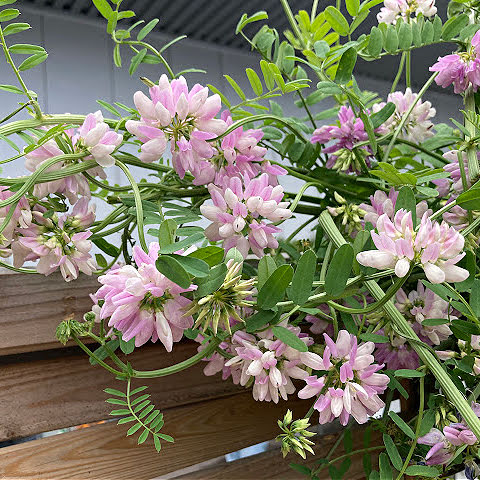
Although there are plenty of climbers to choose from, I think it is important not to plant one that is too vigorous for your garden. Otherwise, you may create a load of work in pruning, to try to keep it within its allotted space, and run the risk of it intruding in your neighbours’ gardens.
Years ago, I made the mistake of planting the very fast-growing climber Fallopia baldschuanica (Russian vine) to soften and disguise the side of a small, but rather ugly shed. Within three years I regretted my decision and had to dig the plant up and start again with another climber that was more appropriate for the space. We live and learn and I certainly learnt my lesson with that one!
The climbers I’ve selected in this list are all well-behaved, or easy to restrict, offer colour, scent, structure and interest and shouldn’t create lots of work.
Coronilla valentina subsp. glauca ‘Citrina’

Here’s one to entice you into the garden during winter. This lovely shrub can be grown against a wall, fence or trellis. It produces cheerful yellow flowers during the coldest months of the year and the lemony floral fragrance that can be detected from several feet away! Usual height 1m, although the plant in my garden reached over 1.2m, and 1m spread. The leaves are a blue-grey green and as an evergreen shrub, they provide interest all year round. Coronilla valentina subsp. glauca ‘Citrina’requires full sun and a sheltered position and is hardy across most of the UK. It may struggle in temperatures below -10C, but ours survived ‘the beast from the east’ of 2018 without difficulty.
Rosa ‘Gertrude Jekyll’
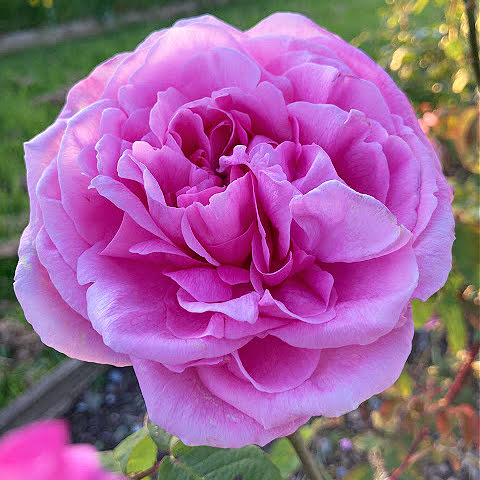
Recently voted the world’s favourite rose, this climbing version has the same very fragrant flowers. A short climber that grows to 250cm and has bright pink flowers that are strongly scented of old rose. A repeat flowering plant that is often the first to flower in the season and, particularly with regular deadheading, will continue to flower for months. Grow in full sun or partial shade in any soil type. To get the best from Rosa Gertrude Jekyll (‘Ausbord’PBR) (S), prune once annually. Hardy across all of UK and Ireland. One of the ideal climbing plants for small gardens.
Billardiera heterophylla

The common name for this plant is Bluebell creeper and I can see why. The pendent, bell-shaped flowers are blue and appear from June to September. The flowers are followed by blue berries that are edible. It is not hardy in UK, so will need to be grown under glass protection during the winter. Grow in full sun in a sheltered spot, in well-draining soil. Water generously for the first year until established. Height and spread 200cm. Try growing in a tub plant on a wheeled base to allow for easier movement. Water sparingly during winter. If you are searching for one for your garden, it is often listed as Sollya Hetrophylla.
Actinidia Kolomikta
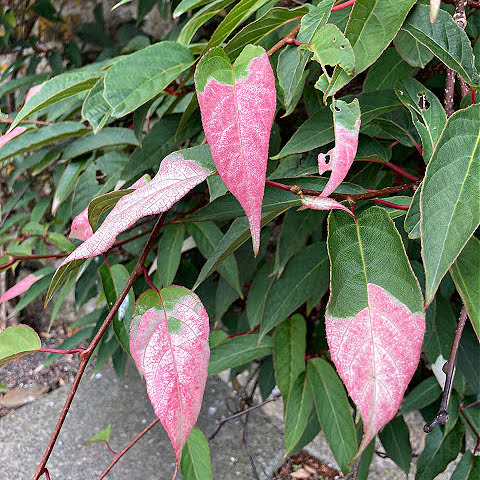
Usually described as a vigorous twining climber, which would exclude it from this list of plants You can grow Actinidia Kolomikta in a large container or restrict its roots in the ground, and prune it to keep it within an acceptable size for your space. At Aberglasney Gardens, there is one growing happily in a small planting pocket in the patio, next to the building wall, outside the café. Grown for the leaves which have white and pink tips. To bring out the best colour in the leaves, grow in full sun, in a south-facing spot, in any type of garden soil. It is hardy throughout UK and Ireland, even in a severe winter. Height and spread, in excess of 400cm if left unpruned.
Clematis ‘Elpis’

New for 2025, this richly coloured clematis is a late flowering variety, producing flowers from July to September. I have had one of these plants since the start of the year (I was lucky to be given a press sample) and I’ve been really impressed with the how well it has performed, with lots of flowers and rich foliage. It is a compact climber, growing to 120cm, so it ideal for planters or near the front of the border. Clematis ‘Elpis’ (‘EviGsy154’) (PBR) is easy to care for, just cut all the stems back to about 15cm above the soil level in late winter or early spring. Grow in partial shade. Hardy across UK and Ireland.
Lonicera × brownii ‘Dropmore Scarlet’
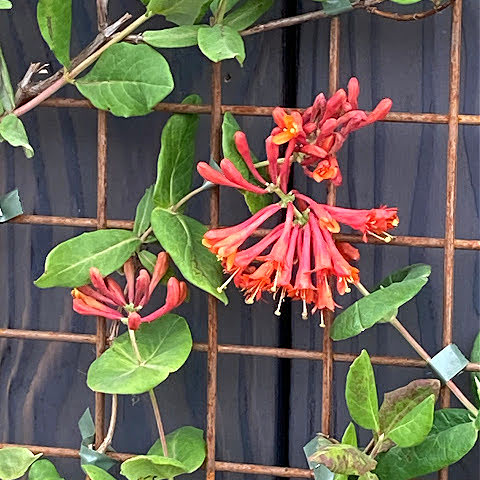
Although it has little to no fragrance, this honeysuckle provides plenty of interest with bright scarlet flowers, blue-green leaves and inedible red berries. It is semi-evergreen, but may lose all its leaves in a severe winter. However, it is fully hardy and so will regrow the leaves the next spring. Grow in full sun or partial shade. Avoid dry conditions and plant well away from the base of a wall or tree. Height 400cm and 200cm spread.
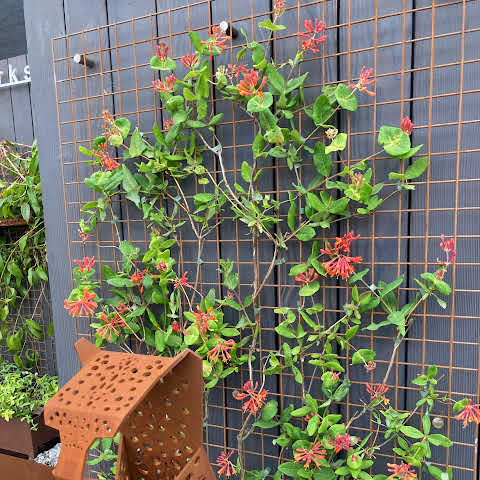
I saw one growing in a courtyard garden at RHS Chelsea this year and loved the way it contrasted with a dark wall behind it and complemented the rusted ironwork around it. It clearly demonstrated why these are such good climbing plants for small gardens.
Phaseolus coccineus
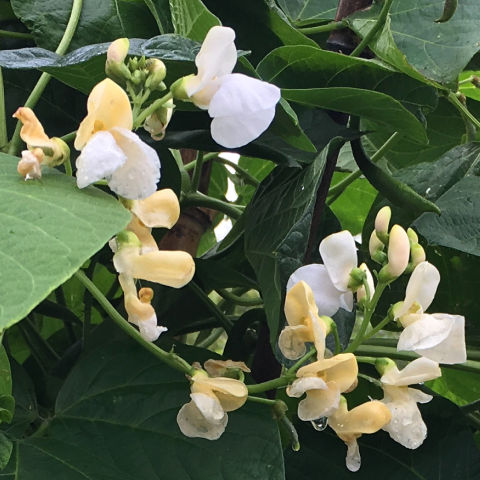
Originally introduced to the UK as ornamental plants because of their attractive flowers. Cover a tower, arch or trellis with flowers using what is more commonly known as a runner bean. Usually grown as an annual, but runner beans may overwinter in soil that does not become waterlogged or where the soil is not frozen for prolonged periods. To make a tower, use 3-7 canes pushed in the soil in a circle and secure together at the top. Grow one or two runner beans at each cane. The plants will quickly climb the canes and start flowering. Pick the bean pods regularly for continued flower production. I prefer white-flowered runner beans, which produce a white bean inside the pod. Try ‘Czar’ or ‘White Lady’. But runner beans offer a range of flower colours, ‘Painted Lady’ has bi-colour flowers of orange-red, while ‘Scarlet Emperor’ has red flowers.
Supports for climbing plants
When it comes to supporting your climbing plants, there is a wide choice of options. I’ve tried and tested some of the support structures that can be created at home. I was looking for the best support for climbing beans, but the same structures could be used for any climbing plant.
You could also use a tree as a support for climbing plants, check out my suggestions for colourful trees for small gardens.
More information
The article about flowers for Climbing Plants for Small Gardens was written for Amateur Gardening magazine and published in summer 2025. I may have updated some of the specific varieties and images and added further suggestions. Additionally, links are included to help you find the suggested plants and also links to purchase via Amazon are included in brackets where available.

- White Flowers for Winter Containers - March 13, 2026
- Heavenly plants easy gardening - February 27, 2026
- Plants to divide in autumn - January 31, 2026