

Plants to divide in autumn
Plants to divide in autumn. One of the delightful traits of herbaceous perennials is that they spread, usually spreading outwards from the centre. This gives us the opportunity to lift and divide, or even just cut and remove, segments of the clump. And for no additional cost, we have new plants to add to the garden, give to friends, or donate to plant swaps, community gardens etc.
As a general guideline, herbaceous plants that flower before midsummer’s day can be divided in autumn, and those that flower after Midsummer, can be divided in spring. However, ornamental grasses are best left until spring when they start growing vigorously again. And of course, there are exceptions to the guide too.

Garden centres offer a wide range of plants, and don’t be afraid to search for plants from specialist nurseries to find the exact variety that you want for your garden. I usually purchase one or three plants, depending on the space I have to fill and my available budget, knowning that it won’t be too long before they are sufficiently large to divide to create more plants.
Here area few of the herbaceous perennials that respond well to being divided in autumn.
Hemerocalis

Commonly known as the daylily, each flower is short-lived, but more flowers quickly open. Flowering from June to September, the blooms are held above the strap-like leaves at the top of the fairly stiff flower stems. Hemerocallis are available in a wide range of colours from darkest red-brown to off-white. Height depending on variety from 20cm to 150cm and spread 30cm to 75cm. These easy-to-grow plants are unfussy about soil and situation, and will thrive in full sun and partial shade. In the past, I’ve grown varieties with a gentle orange, double flower, Hemerocallis lilioasphodelus which has a single, yellow flower, and also a cream flower with plum centre called ‘Wild Horses’.
Geranium phaeum ‘Joseph Green’

All hardy geraniums can be divided in autumn. I spotted this variety during a garden visit to and instantly knew the place I would like one in my garden. ‘Joseph Green’ is the only Geranium phaeum with double flowers, and they are the deepest purple, with green stigmas. The flowers are held above the bright green foliage. Height 40cm and 45cm spread. Grow in any soil type, on any aspect, as long as the ground does not become waterlogged in winter. It grows happily in full sun, partial shade or even shadier areas of the garden. ‘Joseph Green’ is fully hardy, making it ideal for gardens throughout the UK and Ireland. The flowers are sterile, so division is the easiest way to propagate more plants.
Lysimachia punctate ‘Alexander’

Yellow Loosestrife is a common sight in gardens, and this variety has the added interest of cream and green variegated foliage that is blushed with pink in spring. It is a vigorous grower and will quickly form a large clump. During the summer intense yellow flowers appear at the leaf axils giving a strong display of colour in the border. Grow in full sun or partial shade and it prefers moist, but well-drained loam or clay soils. It will also grow in boggy areas if you keep the crown above water level. Height 60-90cm and 60cm spread.
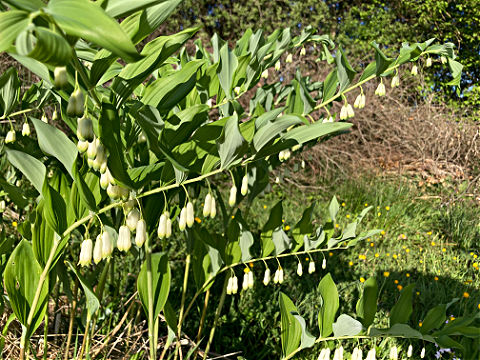
Polygonatum × hybridum

Every spring, I look forward to seeing the new growing tips of Solomon’s Seal pushing up through the soil. The creamy flowers dangle from the arching stems beneath the leaves and look precariously fragile. But inevitably, I watch them sway and dance in the spring breezes, resolutely held in place until the blooms fade. They often produce a berry, which can be toxic to humans.
Sawfly can be a nuisance, and they can strip a plant of its leaves in a very short time. The good news is that although it’s unsightly, it does not usually do permanent damage and the plant will grow again next year. Keep an eye open for signs of damage and remove sawfly larvae if you see them. Alternatively, encourage plenty of wild birds into your garden as they can help to reduce sawfly larvae numbers.
Papaver orientale

Oriental poppies have showy, but short-lived flowers. Luckily, an established clump will continue to bloom over a period of weeks. They are easy to grow on all soil types. Plants require full sun and it will fail to thrive in very dry or waterlogged soils. Height 90cm. Probably most well-known with pillar-box red papery petals with a dark or black centre, other colours are also available. Try ‘Coral Reef’ for a delicate peachy-pink flower. Propagate by dividing clumps every 3-4 years.
Lamprocapnos spectabilis

Recently reclassified from Dicentra spectabilis, it is commonly known as bleeding heart. Easy to identify when in bloom, because the heart-shaped flowers look like they float beneath the arching stems. This herbaceous perennial makes an appearance in the first half of the year, disappearing again by mid-summer, making it ideal to grow among autumn flowering plants, to provide interest and colour in the same space for an extended period. Lamprocapnos spectabilis has fresh-to-mid green leaves that have lobed or cut leaflets and provide a perfect foil for the flowers which range from dark pink to white.
Phlox paniculata ‘Mount Fuji’ (Fujiyama)
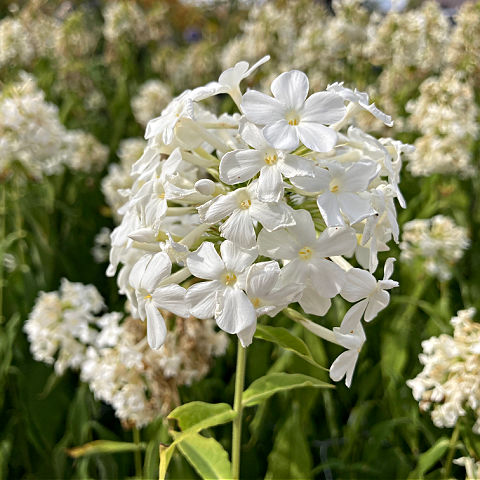
Phlox plants can be divided in autumn. I’m particularly taken with a crisp white variety called ‘Mount Fuji’ that I saw at Llysdinam Gardens in Powys. The fragrance from the flowers filled the air around them. It grows to 75cm in height and produces panicles of flowers on top of the leaf stems during early to mid summer. Grow in all soils except sandy soil, it prefers moist but well-drained conditions. Happy in full sun and partial shade, phlox may fail to thrive on a north-facing site. Fully hardy, even during a severe winter.
Phomis russelania

A fast-growing herbaceous perennial that spreads quickly forming a weed-suppressing mat of leaves. It starts flowering in late spring and produces strong stems with whorls of yellow flowers up the stem. Leave some flower stems throughout the winter to add interest to the winter garden. Grow in full sun. It will fail to thrive on heavy and clay soils, but I’ve noted that it copes well in our raised beds which lift the roots out of the clay soil in our garden. Height and spread 90cm. Hardy throughout UK, Ireland and the rest of northern Europe.
Peonies

Herbaceous peonies die back each autumn and regrow from ground level in spring. There is a huge array of colours, flower shape and size to choose from. Kelways Plants stocks a wide range of peonies or for a good reference book, choose Peonies by Claire Austin. You do not need to divide peonies, they will grow happily undisturbed for many years. However, if you’d like more plants, or to move the peony, you can do so in autumn.
Wait until the leaves have died back and the plant is dormant. Once lifted, wash the soil away from the roots, so that you can see the pink ‘eyes’, which are actually the leaf buds. Use a sharp spade or knife to cut the roots into sections making sure that you include several ‘eyes’ on each section. Replant in a new area of the garden or return to the existing planting pocket. Do not plant the eyes more than 2.5cm below soil level and it can cause the plants to grow without flowering.
I plant all my peonies with the eyes just above ground level to allow me to mulch each year without burying the plants. One of my favourite herbaceous peonies is Peony ‘Monsieur Jules Elie’, for its fully double, pink flowers and fragrance.

- White Flowers for Winter Containers - March 13, 2026
- Heavenly plants easy gardening - February 27, 2026
- Plants to divide in autumn - January 31, 2026